
A reliable cargo service in Dubai should look at the shipment itself before recommending road or air freight.
Choosing between road and air freight sounds simple. Need it fast? Send it by air. Want to save on transport costs? Use road freight.
But GCC cargo rarely works on that logic alone.
A truckload of retail inventory moving from Dubai to Riyadh has very different requirements from an urgent machine component needed in Doha. Cargo weight, volume, destination, customs requirements, and the cost of arriving late all affect the decision.
For UAE businesses serving Saudi Arabia, Oman, Kuwait, Qatar, and Bahrain, choosing the right freight mode can directly affect inventory, delivery commitments, and logistics costs.
So, which one makes more sense for GCC cargo?
How to Choose the Right Freight Mode
A dependable cargo service in Dubai should assess these factors rather than recommend the same transport method for every shipment.
Freight decisions affect more than the shipping bill.
Take a retailer replenishing stores in Riyadh. If stock is planned several days ahead, road freight can move regular pallet loads at a manageable cost.
Now consider a factory waiting for one critical spare part. If production has stopped, saving on freight means very little. A few extra hours of downtime may cost more than the air cargo charge.
A useful question is:
What will it cost the business if this shipment arrives late?
That answer often makes the road-versus-air decision much clearer.
Road Freight from Dubai to GCC: Built for Regional Cargo
Road transport is one of the most practical options for commercial cargo moving between the UAE and GCC countries.
Dubai is connected by established road networks to Riyadh, Jeddah, Dammam, Muscat, Sohar, Doha, Kuwait City, and Manama. This makes road freight GCC particularly useful for regular stock movement, commercial loads, and regional distribution.
The main advantage is direct movement.
Cargo can be collected from a warehouse in Dubai and transported towards the consignee with fewer handling stages than a typical airport cargo journey. A truck loaded with retail stock, for example, can move from Dubai towards a distribution centre in Riyadh as one coordinated shipment.
For recurring GCC deliveries, that flexibility matters.
When Road Freight Makes More Sense
Road freight is usually the practical choice for heavy, bulky, or high-volume cargo.
Construction materials, industrial equipment, machinery, furniture, automotive parts, FMCG products, and palletised retail stock are commonly moved by road.
Cost becomes particularly important as shipment weight increases. Air freight pricing can rise quickly based on actual or volumetric weight, while trucks provide more usable capacity for commercial loads.
Businesses can also choose between FTL and LTL transport.
Full Truck Load (FTL) provides dedicated truck capacity and suits larger shipments. Less than Truck Load (LTL) allows smaller loads to share vehicle capacity, making it a practical option when a business does not need an entire truck.
This flexibility is one reason land transportation UAE remains so important to regional trade.
Dubai to Saudi Road Transportation
Dubai to Saudi road transportation supports retail replenishment, machinery, industrial supplies, building materials, project cargo, and general commercial goods.
Saudi Arabia is a major destination for cargo moving from the UAE.
Routes such as Dubai to Riyadh trucking and Dubai to Riyadh road transport are widely used by businesses serving the Saudi capital. Jeddah and Dammam require different route planning based on the cargo and final delivery point.
The truck is only one part of the journey. Documentation, border coordination, and vehicle selection can all affect the actual transit time.
A fast-moving truck gains little if incorrect cargo paperwork leaves it waiting at the border.
Dubai to Oman Cargo Services
Oman is another important road freight market for UAE businesses.
Dubai to Oman cargo services handle retail goods, industrial supplies, equipment, and recurring commercial stock. For shipments heading to Muscat, road transport can support direct regional movement and door-to-door coordination.
Businesses also use land freight UAE to Oman for scheduled stock replenishment and distribution.
The appeal is straightforward: cargo can leave a warehouse in Dubai and move towards the consignee in Oman through one coordinated logistics process.
Road Cargo to Kuwait, Qatar, and Bahrain
Road networks also connect Dubai with Kuwait, Qatar, and Bahrain.
Dubai to Kuwait cargo services are used for retail stock, industrial goods, and commercial inventory moving towards Kuwait City and other destinations.
For Doha-bound cargo, road freight can be a practical option for planned distribution where capacity and transport cost matter more than urgent delivery.
Similarly, Dubai to Bahrain door-to-door cargo services can bring pickup, cross-border transport, customs coordination, and delivery into one workflow.
This is one of the main benefits of door to door cargo GCC services. Businesses have fewer separate transport stages to manage themselves.
When Air Freight Is Worth the Extra Cost
Air freight earns its place when time becomes the main concern.
Imagine a manufacturer waiting for a specialised component before production can restart. A two- or three-day delay could cost far more than the air freight charge.
Urgent medical supplies, high-value electronics, aviation parts, certain pharmaceuticals, and luxury goods are other examples where air cargo may be the better choice.
Air freight generally suits cargo that is:
- Urgent
- Lightweight and high-value
- Sensitive to delays
- Required to prevent operational disruption
The freight rate should not be considered in isolation.
If a late shipment means lost production, missed sales, or a serious customer issue, paying more for air freight may actually be the less expensive business decision.
Road Freight vs Air Freight: Look Beyond the Quote
For heavy and high-volume GCC cargo, road freight is generally more cost-effective. FTL and LTL options also give businesses more control over how they use transport capacity.
Air freight costs more, particularly for larger or heavier shipments. Airport handling and special cargo requirements can add to the final cost.
But the cheapest quote does not always produce the lowest overall cost.
A retailer can save on freight and still lose money by missing a sales campaign. A manufacturer can choose cheaper transport and then lose production time waiting for a part.
Before choosing, businesses should consider:
- Freight cost
- Urgency
- Cargo value
- Shipment weight
- Inventory needs
- Customer commitments
- The cost of a delay
Customs Can Change the Real Transit Time
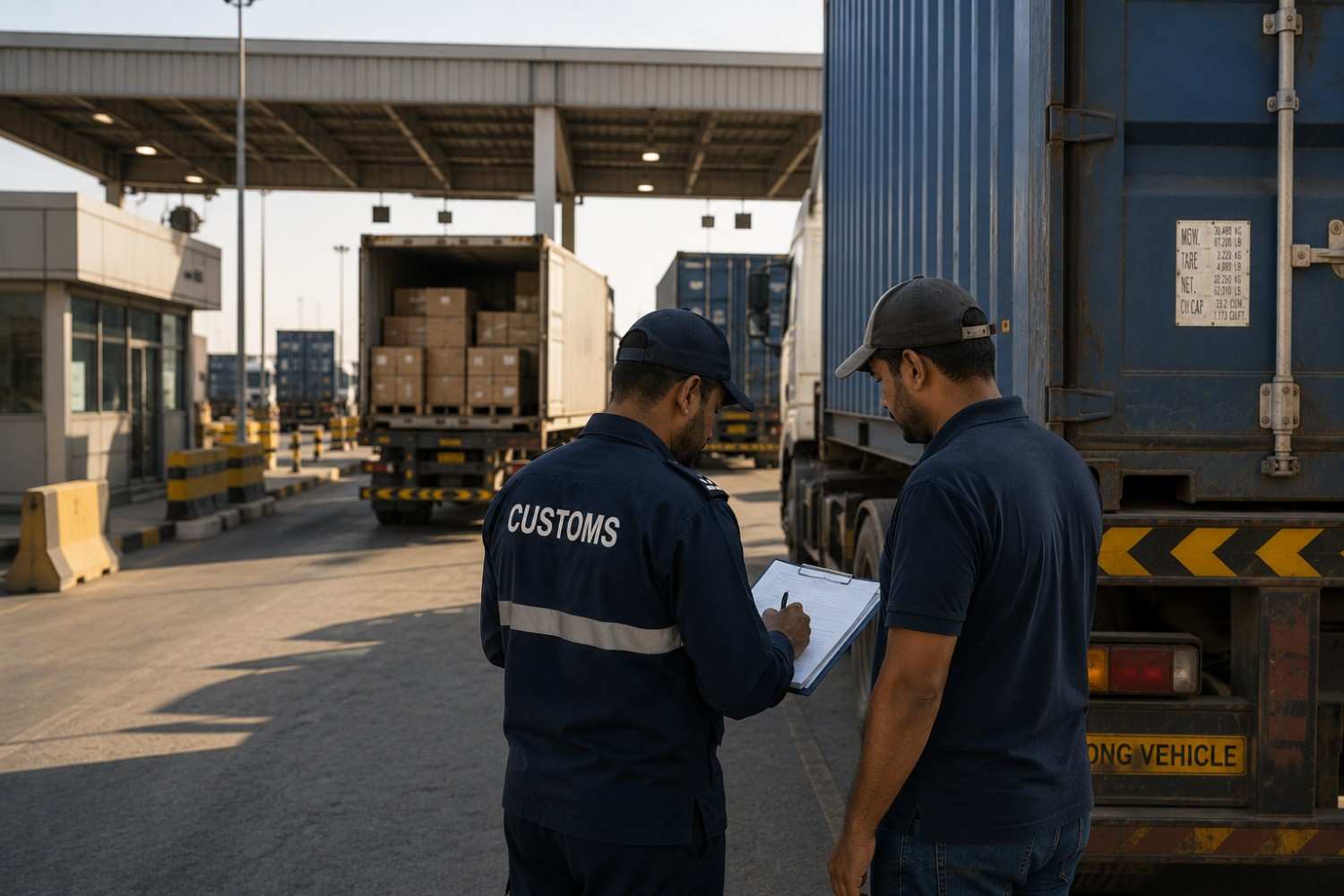
Cross-border GCC road freight depends heavily on accurate documentation.
Commercial invoices, packing lists, certificates of origin, customs declarations, and product-specific documents may be required depending on the shipment.
Accurate HS classification also matters. Incorrect cargo details can trigger checks and delay border clearance.
Professional customs clearance Dubai support helps businesses identify documentation issues before the truck reaches the border.
Air freight also involves customs and cargo processing. Although the flight itself may take only hours, airport handling, clearance, and final delivery still form part of the total journey.
So the better question is not:
“How fast does the truck or aircraft travel?”
It is:
“How long will the cargo take from pickup to final delivery?”
Why Door-to-Door Movement Gives Road Freight an Advantage
Air cargo normally passes through several stages:
- Pickup
- Airport handling
- Flight
- Destination handling
- Customs
- Final delivery
Road freight can be more direct.
Cargo can be collected from a warehouse, loaded onto the right vehicle, moved across the GCC route, cleared at the border, and delivered towards the consignee.
This works particularly well for businesses combining transport with warehousing in Dubai UAE or storage in Dubai UAE. Stock can be stored, picked, prepared, and moved directly into the road freight network.
A 3PL logistics company Dubai can bring warehousing, customs coordination, transportation, and delivery together instead of treating each stage as a separate operation.
E-Commerce Is Changing GCC Freight Planning
Online businesses face a difficult balance. Customers expect faster delivery, but sending every cross-border order by air is rarely economical.
Businesses using e-commerce fulfilment Dubai operations can hold stock in the UAE and select freight based on the actual order.
Regular stock movement may go by road. Urgent or high-value shipments can use faster transport.
An integrated fulfillment service Dubai can connect storage, pick and pack, order processing, and dispatch. The same logistics planning supports Amazon seller fulfillment UAE, Shopify fulfillment UAE, and wider order fulfillment UAE operations.
Customers only see the promised delivery date. Behind it is a chain of warehouse and transport decisions.
Road Freight or Air Freight? Sometimes the Answer Is Both
Many businesses do not need to choose one mode for every shipment.
A distributor may send weekly stock to Saudi Arabia by road but use air cargo when replacement inventory is urgently needed.
An automotive parts supplier can move regular pallet loads by truck and fly one critical component when equipment downtime becomes expensive.
Goods arriving through Jebel Ali may also move into storage in Dubai UAE, pass through a warehouse or fulfillment center Dubai, and then be distributed across the GCC by road. Urgent stock can take the air route.
This mixed approach keeps routine logistics costs under control without slowing down shipments that genuinely cannot wait.
A good cargo service in Dubai should help businesses make that distinction.
A Simple Example
Consider a Dubai spare parts distributor supplying customers in Riyadh.
Regular pallets of commonly ordered parts are planned in advance. Road freight makes sense because the priority is reliable stock replenishment at a controlled transport cost.
Then a customer urgently needs one specialised component to restart a machine.
Waiting for the next truck could cost the customer more than the air freight charge. For that one shipment, air cargo is the better option.
Same industry. Same destination.
Different levels of urgency.
That is how freight mode decisions should be made.
The Final Verdict: Is Road Freight or Air Freight Better?
For most regular commercial cargo moving from Dubai to GCC countries, road freight provides a strong balance of cost, capacity, flexibility, and door-to-door connectivity.
It is particularly suitable for retail inventory, industrial equipment, machinery, construction materials, FMCG products, automotive parts, and planned commercial shipments.
Air freight is the premium option when time matters more than transportation cost. Urgent components, high-value goods, sensitive products, and critical shipments may justify the faster transit and additional expense.
The most effective logistics strategy is not about choosing one mode permanently.
It is about choosing the right mode for each shipment.
As regional trade continues to grow, UAE businesses that make freight decisions based on cargo type, urgency, cost, and commercial impact will be better positioned to control logistics expenses while maintaining reliable customer service.
For companies moving cargo across Saudi Arabia, Oman, Kuwait, Qatar, Bahrain, and the wider GCC, the right logistics partner can make that decision significantly easier.
Explore Our Services
- Cargo Services in Dubai
- Dubai to Saudi Road Transportation
- Dubai to Oman Cargo Services
Frequently Asked Questions (FAQ)
Road freight is generally more cost-effective for heavy, bulky, palletised, and high-volume commercial shipments. Air freight may cost more but can be commercially valuable when urgent delivery prevents downtime, lost sales, or supply chain disruption.
Transit time depends on the destination, border processing, cargo type, documentation, and delivery location. Routes such as Dubai to Oman cargo may differ significantly from longer road movements towards Saudi Arabia or Kuwait, so businesses should request a route-specific estimate.
Road freight is commonly used for retail stock, machinery, industrial equipment, automotive parts, construction materials, FMCG goods, furniture, and palletised commercial cargo. FTL and LTL options can support different shipment volumes.
Air freight is usually better for urgent, lightweight, high-value, or time-sensitive goods. Critical spare parts, certain pharmaceuticals, electronics, and emergency replenishment shipments are common examples.
Yes. Door-to-door cargo GCC services can coordinate cargo pickup in the UAE, cross-border transportation, customs procedures, and final delivery, depending on the destination and service requirements.
Yes. Missing or inaccurate shipment documentation can delay border clearance. Proper commercial invoices, packing lists, commodity classification, and destination-specific documentation are important for efficient cross-border movement.
Absolutely. Many businesses use road freight for regular and bulk cargo while reserving air freight for urgent shipments. A hybrid logistics strategy can help balance transportation costs and delivery performance.
Need Help Choosing the Right Freight Option for Your GCC Shipment?
Every shipment has different priorities. Cargo size, destination, urgency, handling requirements, and budget all influence whether road or air freight is the better choice.
Dashgo Logistics provides cargo and regional transportation solutions designed around actual shipment requirements. Whether you’re planning Dubai to Saudi cargo, Dubai to Oman cargo, Dubai to Kuwait cargo, or wider GCC distribution, the right freight strategy starts with understanding your cargo.
Get a free quote today or contact the Dashgo team via WhatsApp for shipment guidance.
Most cargo quotations are provided within 60 minutes during business hours.